Arabic
 French
 Deutsch
 Urdu
Urdu Pashto
 Swahili
 Hausa
Hausa

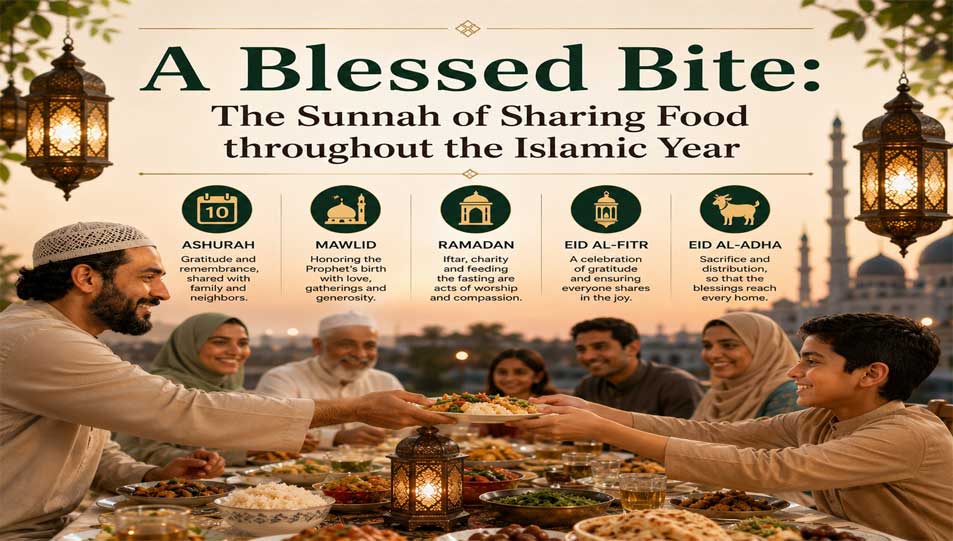
A Blessed Bite: The Sunnah of Sharing Food throughout the Islamic Year
Dr. Heba Salah
Senior Researcher & Translator
For Muslims, food is more than nourishment. It is a blessing from God, a means of expressing gratitude, and one of the most enduring ways through which faith is translated into daily life. Throughout the Islamic year, major religious occasions are often accompanied by acts of feeding, hospitality, and communal meals, reflecting a profound Prophetic tradition: that blessings increase when they are shared.
As the Islamic year begins with the Day of ʿĀshūrāʾ, believers are reminded of God’s mercy and deliverance. Prophet Muhammad (peace and blessings be upon him) fasted on this day in gratitude to God for saving Prophet Moses and his people, saying: "We have more right to Moses than they [the Jews] do." (Bukhārī and Muslim)
While fasting is the central Sunnah of ʿĀshūrāʾ, Muslim communities have historically gathered with family and neighbors, sharing meals after the fast and renewing bonds of kinship and affection. Thus, the new year begins not only with remembrance and worship but also with togetherness.
A few months later comes the commemoration of the birth of the Prophet (peace and blessings be upon him). While Muslims honor his birth primarily by reflecting on his life, character, and teachings, many communities also express their joy through gatherings in which food is prepared and shared. Such occasions serve as reminders that the Prophet's message was one of mercy, generosity, and care for others. Indeed, among his most famous teachings is: "Feed the people and spread peace among those you know and those you do not know." (Bukhārī and Muslim)
The arrival of Ramadan elevates the spiritual significance of food even further. Each evening, families, friends, neighbors, and even strangers gather around iftar tables to break their fast together. The meal becomes more than the end of a day's abstinence; it becomes an expression of gratitude, solidarity, and compassion.
The Prophet (peace and blessings be upon him) encouraged believers to participate in this spirit of generosity, saying: "Whoever provides food for a fasting person to break his fast will have a reward like theirs without diminishing the reward of the fasting person in the slightest." (At-Tirmidhī)
Throughout Ramadan, mosques, homes, and charitable organizations become centers of hospitality, feeding worshippers, travelers, and those in need. In many places, communal iftars embody the Qur'anic ideal: "And they give food, in spite of love for it, to the needy, the orphan, and the captive." (Qur'an 76:8)
The month concludes with Eid al-Fitr, a celebration that begins with an act directly connected to feeding others. Before the Eid prayer, Muslims are required to pay Zakat al-Fitr so that every member of society can partake in the joy of the occasion. The festival meal shared with relatives, friends, and neighbors reflects the Islamic vision of a community in which happiness is collective rather than individual. The Prophet (peace and blessings be upon him) emphasized hospitality and generosity, saying: "Whoever believes in Allah and the Last Day should honor his guest." (Bukhārī and Muslim)
The spirit of sharing reaches its peak during Eid al-Adha. Commemorating the devotion of Prophet Ibrahim (Abraham), this blessed occasion centers around sacrifice and distribution. The meat of the sacrifice is traditionally divided among family, relatives, neighbors, and the poor, ensuring that the blessings of the day extend throughout the community. The Qur'an highlights this purpose when speaking about sacrificial animals: "Then eat from them and feed the needy and the poor." (Qur'an 22:28)
Thus, Eid al-Adha transforms an act of worship into an act of social solidarity. The sacrifice is not merely about offering; it is about sharing.
Running through all these occasions is a single Prophetic principle: food is meant to bring people together. The Messenger of God (peace and blessings be upon him) taught: "The food of one person is sufficient for two, the food of two is sufficient for four, and the food of four is sufficient for eight." (Muslim)
This teaching reflects a timeless truth. The blessing of food lies not only in its quantity but in the generosity with which it is shared.
From the fasting of ʿĀshūrāʾ to the gatherings of Mawlid, from the communal iftars of Ramadan to the celebrations of Eid al-Fitr and the sacrifices of Eid al-Adha, food accompanies Muslims throughout the sacred calendar. Yet its role extends far beyond satisfying hunger. It strengthens family ties, nurtures friendships, supports the vulnerable, and creates memories that endure across generations.
In a world increasingly shaped by individualism and virtual interaction, the Sunnah of sharing food remains a powerful reminder that faith is lived through human connection. A shared meal becomes an act of worship, a gesture of mercy, and a source of belonging. Through every season of the Islamic year, the dining table continues to serve as a place where hearts meet, blessings multiply, and communities are strengthened, one blessed bite at a time.