Arabic
 French
 Deutsch
 Urdu
 Pashto
 Swahili
 Hausa
Egypt’s Grand Mufti Meets UN Special Envoy to Combat Islamophobia, Discusses Joint Efforts to Promote the True Message of Tolerant Islam
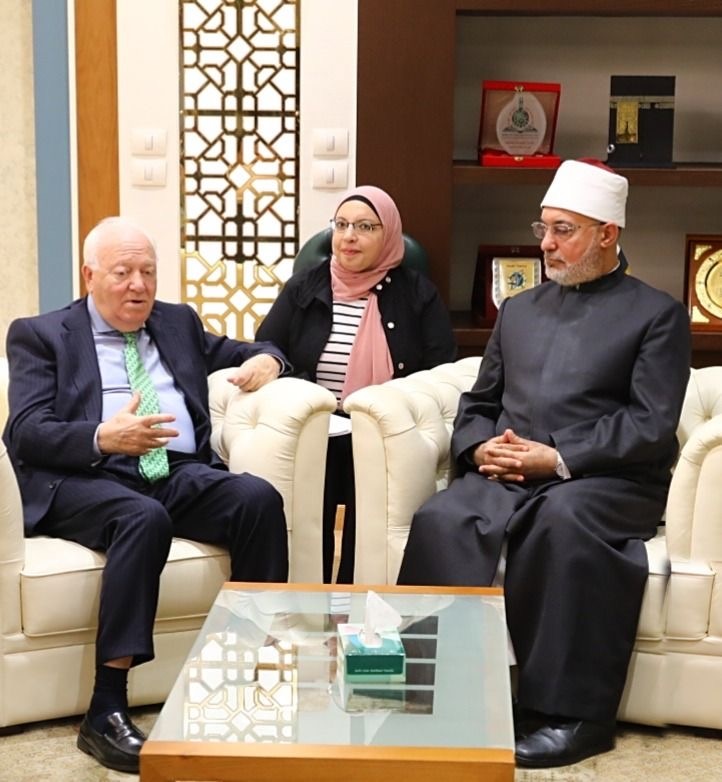
During His Meeting with the UN High Representative for the Alliance of Civilizations and Special Envoy to Combat Islamophobia
Key Highlights
• Grand Mufti of Egypt: Combating Islamophobia is a shared international and humanitarian responsibility. Islamophobia and extremism are two sides of the same crisis.
• Grand Mufti of Egypt: The gap between international laws and their implementation has contributed to concealing facts and allowing violations against Muslims in various parts of the world to persist.
• Grand Mufti of Egypt: Justice is indivisible, and human rights must be upheld without political, religious, or geographical selectivity.
• Grand Mufti of Egypt Highlights Women's Rights in Islam, including the philosophy of inheritance, participation in all spheres of life, and access to senior leadership positions.
• Grand Mufti of Egypt Clarifies the Distinction between Jihad and Terrorism, outlining the ethical and humanitarian principles Islam establishes for warfare.
• Grand Mufti of Egypt Calls for Ethical Governance of Artificial Intelligence to prevent its misuse in spreading hate speech, disinformation, and prejudice against religions and cultures.
• UN High Representative Expresses Deep Concern over the Growing Incidence of Islamophobia Worldwide and its adverse impact on social cohesion and human rights.
• UN High Representative: We are working to develop an international ethical charter for artificial intelligence to ensure that it serves humanity and safeguards societies against disinformation and hate speech.
• Both Sides Agree to Explore Concrete Cooperation, including establishing a joint working group, producing multilingual awareness content, organizing media training, and collaborating on the ethical governance of artificial intelligence.
His Eminence Dr. Nazir Mohammed Ayyad, Grand Mufti of Egypt and President of the General Secretariat for Fatwa Authorities Worldwide, received Mr. Miguel Ángel Moratinos, United Nations Under-Secretary-General, High Representative for the United Nations Alliance of Civilizations, and UN Special Envoy to Combat Islamophobia. The meeting focused on exploring avenues for joint cooperation to counter hate speech, promote intercultural and interfaith dialogue, address pressing intellectual and human rights issues, and advance the ethical and responsible use of emerging technologies.
At the outset, the Grand Mufti welcomed the High Representative, stressing that combating Islamophobia is a shared international and humanitarian responsibility that extends beyond Muslim communities. It is fundamentally linked to safeguarding social peace and upholding human dignity, regardless of religion, race, or cultural background. He emphasized that Islamophobia and extremism are two sides of the same crisis: misconceptions and negative stereotypes about Islam fuel hate speech, while extremist practices reinforce those stereotypes. To this effect, promoting sound religious knowledge and correcting misconceptions are essential to confronting both phenomena.
The discussions also addressed Western perceptions of Islam's position on women and their rights. The Grand Mufti outlined the rights guaranteed to women under Islamic law and the dignity and status accorded to them. He explained the philosophy underpinning inheritance in Islam as part of an integrated system of rights, duties, and responsibilities, cautioning against selective interpretations that detach individual rulings from their broader objectives and contexts. He also highlighted women's right to participate in all spheres of life and assume senior and leadership positions, challenging stereotypes that misrepresent Islam's teachings and legislation concerning women.
His Eminence further clarified the concept of jihad in Islam and its fundamental distinction from terrorism, highlighting the ethical and humanitarian principles governing warfare in Islamic teachings. These principles prohibit aggression and safeguard the sanctity of human life. He stressed that conflating jihad with terrorism is among the approaches exploited to distort Islam's image and misrepresent its true teachings.
Addressing international justice and human rights, the Grand Mufti emphasized that the gap between international laws and conventions and their actual implementation has contributed to concealing facts and perpetuating double standards in responding to the suffering of oppressed communities. He drew attention to the violations and humanitarian suffering endured by Muslims in the Uyghur region, Myanmar, and Gaza, highlighting the stark disparities in the levels of international attention and action afforded to these situations. He stressed that justice is indivisible and that human rights must be protected as a consistent principle, free from political, religious, or geographical considerations.
The meeting also examined the growing influence of artificial intelligence in shaping public awareness and societal attitudes. The Grand Mufti stressed the need for a clear ethical framework governing the use of these technologies to prevent their exploitation in spreading hate speech, disinformation, or prejudice against religions and cultures, while safeguarding human dignity and privacy. He underscored the importance of ethical and religious values in guiding technological advancement, noting that religious and academic institutions can contribute significantly to developing the principles and standards governing this field. Technology, he emphasized, must remain a tool for serving humanity and fostering mutual understanding, rather than deepening divisions and hostility.
The Grand Mufti also outlined the capabilities of Egypt's Dar al-Ifta and its affiliated institutions as potential partners in supporting international efforts in these areas. He highlighted the Haseen Fatwa Online Platform, which provides access to reliable Islamic knowledge in the digital sphere; the Salam Center for Studies of Extremism, which monitors and analyzes extremist discourse and develops evidence-based approaches to countering it; and the Translation Department, which makes the Dar al-Ifta's scholarly and fatwa-related publications accessible in multiple languages, helping correct misconceptions among non-Arabic-speaking audiences.
His Eminence further highlighted the extensive international network of the General Secretariat for Fatwa Authorities Worldwide, which facilitates communication among fatwa institutions, the exchange of expertise, and the coordination of joint initiatives. He also pointed to the potential of the Dar al-Ifta's annual international conference to serve as a platform for global dialogue on combating Islamophobia and promoting the ethical use of emerging technologies.
For his part, the High Representative for the Alliance of Civilizations outlined his mandate as UN Special Envoy to Combat Islamophobia, explaining that it encompasses raising awareness of the phenomenon, tracing its historical roots, monitoring its contemporary manifestations, and following up on the initiatives undertaken by the United Nations and the international community to address it. His work also involves strengthening coordination among governments, international organizations, and religious and civil society institutions to curb the spread of Islamophobia.
The High Representative expressed deep concern over the growing incidence of Islamophobic attacks and incidents worldwide and their detrimental impact on social cohesion and human rights. He noted that his Office is working to develop and implement a UN Action Plan to Combat Islamophobia, focusing on monitoring and documentation, strengthening legislation and preventive policies, and engaging religious, educational, and media institutions in promoting alternative narratives grounded in mutual respect and intercultural understanding.
He identified the gap between legal frameworks and actual practices as a major challenge, noting that it creates room for continued discrimination and the perpetuation of stereotypes. He emphasized the importance of translating international principles and conventions into tangible measures that protect the rights of individuals and communities. He also stressed that combating Islamophobia requires meaningful cooperation with credible religious institutions, given their capacity to present accurate knowledge about Islam and refute misconceptions that fuel hatred.
Regarding artificial intelligence, the High Representative outlined ongoing efforts to develop an international ethical charter governing the use of these technologies, ensuring that they serve humanity and protect societies against disinformation and hate speech. He emphasized the importance of involving religious and academic institutions, alongside technology experts, in formulating the ethical principles governing this field, thereby balancing the benefits of technological advancement with the protection of human values.
Mr. Moratinos welcomed the prospect of enhanced cooperation with Egypt's Dar al-Ifta, expressing his commitment to building an effective partnership to combat Islamophobia and hate speech and promote intercultural and interfaith dialogue. He commended the role played by the Dar al-Ifta and the Grand Mufti in advancing an accurate understanding of Islam. He emphasized that religious leaders and institutions are indispensable partners in confronting both negative stereotypes and the extremist ideologies that reinforce them. He also stressed the need for reliable scholarly sources to help global audiences distinguish between the authentic teachings of Islam and false claims attributed to the religion.
Concluding the meeting, both sides agreed on the importance of translating dialogue and the exchange of perspectives into concrete initiatives. Proposed areas of cooperation include exploring the establishment of a joint working group between Egypt's Dar al-Ifta and the Office of the High Representative to develop a roadmap for collaboration; producing multilingual awareness content to correct misconceptions about Islam; organizing training programs for media professionals and educational institutions on responsible coverage of Islamic affairs; and exchanging data and reports on hate speech and extremist discourse in the digital sphere.
Both sides also agreed to explore the possibility of organizing a joint workshop bringing together religious scholars and technology experts to contribute to international efforts to develop the ethical charter for artificial intelligence. They further discussed inviting the High Representative, or his representative, to participate in the upcoming International Conference of Egypt's Dar al-Ifta.