Arabic
 French
 Deutsch
 Urdu
Urdu Pashto
 Swahili
 Hausa
Hausa

Resolving Family Issues: The Dilemma of AI-Generated Fatwas
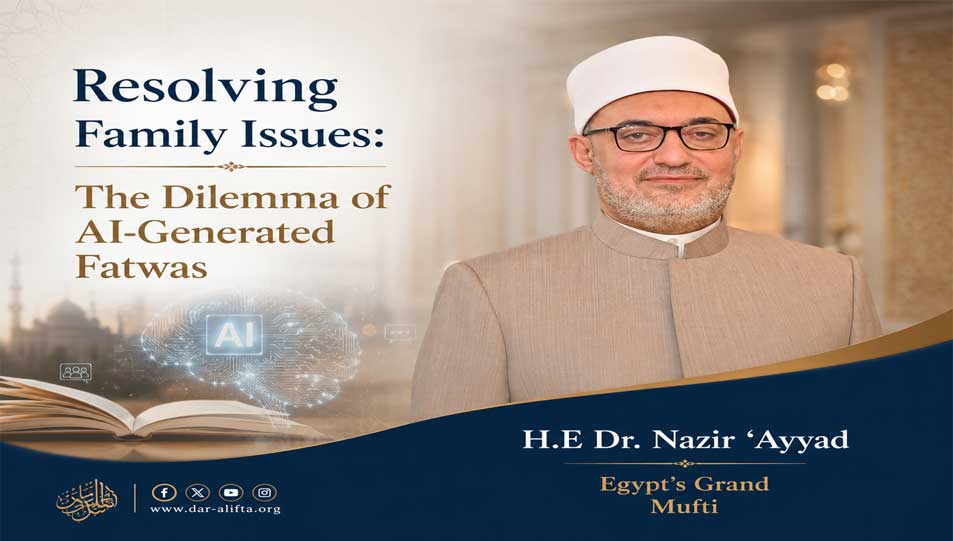
H.E Dr. Nazir ‘Ayyad
Egypt’s Grand Mufti
President of Fatwa Authorities Worldwide
_______________________
A teenager whose parents constantly advise against excessive reliance on AI might ask a seemingly simple yet profound question: “If the Prophet (pbuh) were alive among us today, would he use artificial intelligence?”
The answer lies in understanding the Prophetic approach to life, knowledge, and technology. The Prophet (pbuh) did not teach Muslims to reject the means and tools available to them. Rather, he taught them to employ such means in ways that serve human well-being, uphold moral values, and remain within the boundaries established by the Shari‘ah. The issue, therefore, is not technology itself, but how it is used, for what purpose, and under whose guidance.
Since the family is the foundation of society, parents today find themselves facing a growing range of challenges arising from their children’s excessive or irresponsible use of AI and modern technology. One of the most pressing concerns is the growing tendency to turn to AI to resolve personal, family, and even religious questions—sometimes without recognizing the limitations of technology or the importance of seeking guidance from qualified human experts. The Qur’an establishes a fundamental principle in this regard: “And ask the people of knowledge if you do not know.” (Qur’an 16:43)
This verse places knowledge and qualified expertise at the heart of seeking guidance. It also establishes an important distinction between accessing information and seeking authoritative guidance.
Today, the Muslim family is living through a profound transformation. Digital technology has changed the way family members communicate, raise their children, resolve disagreements, seek advice, and make decisions. A question that once required a conversation with a parent, an elder, a scholar, or a trusted counselor can now be entered into a smartphone and answered within seconds. Artificial intelligence has accelerated this transformation.
A husband experiencing difficulties in his marriage may ask an AI system whether he is right or wrong. A wife facing a family dispute may seek an immediate religious answer online. A teenager confused about a personal or religious matter may turn to an AI chatbot before speaking to a parent, teacher, or scholar.
This development raises an increasingly important question: Can an AI-generated answer be considered a fatwa? The answer requires us to understand what a fatwa actually is.
The hadith connects religious understanding with a deeper form of knowledge, not merely the possession of information, but fiqh, the ability to comprehend the religion and understand how its principles apply to human circumstances. This distinction becomes especially significant in matters concerning the family.
Family questions are rarely isolated legal questions. Behind a question about marriage may be years of disagreement, emotional pain, misunderstanding, financial difficulties, cultural expectations, or concerns about children. A question that appears to require a simple legal ruling may actually require reconciliation, counseling, mediation, or a careful examination of the circumstances before a religious ruling can be appropriately applied. This is where the limitations of AI-generated fatwas become particularly apparent.
Artificial intelligence can process enormous quantities of information and generate remarkably sophisticated responses. It can locate relevant texts, summarize scholarly positions, explain terminology, translate sources, and assist both scholars and the public in accessing knowledge. These are valuable capabilities that should not be dismissed. But the ability to generate an answer is not the same as the authority to issue a fatwa.
This principle is particularly relevant in the age of artificial intelligence. The speed with which an answer can be generated must never be confused with the reliability or authority of that answer.
Indeed, one of the greatest challenges of our digital age is that certainty can be manufactured more quickly than knowledge can be acquired.
An AI-generated response may sound confident, cite a verse or hadith, and present a ruling in polished language. Yet confidence in presentation does not establish correctness. A response may overlook a difference between schools of jurisprudence, misunderstand the circumstances, rely upon an inappropriate analogy, or combine opinions from different contexts in a way that produces a conclusion no qualified scholar would endorse.
The danger becomes even greater when the answer concerns marriage and family relationships, because an incorrect answer can have consequences far beyond the screen.
A person who receives an AI-generated response declaring a spouse sinful, a marriage invalid, a divorce effective, or a particular family decision obligatory may act upon it immediately. In doing so, a technological tool intended to provide information could unintentionally contribute to the breakdown of a family.
This Qur’anic approach offers an important lesson for our technological age: complex human relationships cannot always be reduced to automated answers.
There is also a Prophetic principle that should guide our approach to technological innovation. The Prophet (pbuh) said: “You are more knowledgeable about the affairs of your worldly life.”(Sahih Muslim)
This hadith demonstrates that Islam does not reject human experience, expertise, experimentation, or the development of worldly means. Technology is therefore not inherently opposed to religion. Rather, it must be placed within a framework of ethical responsibility and sound knowledge.
Artificial intelligence can—and should—serve religious life in beneficial ways. It can help people locate authentic sources, learn basic concepts, explore different scholarly opinions, overcome language barriers, and formulate their questions before approaching qualified scholars. Religious institutions can also employ AI responsibly to organize knowledge, improve accessibility, and reach new generations. But AI should remain a servant of knowledge, not an authority over it.
This distinction is especially important for young people. A teenager should be taught that asking an AI system a religious question is not necessarily wrong. What matters is understanding the limits of the answer. AI may help a young person discover information, but when the question concerns a serious personal, family, or religious matter, the next step should be to consult a trustworthy and qualified human authority.
The responsibility does not rest upon individuals alone. Religious institutions and scholars must also respond to this new reality. The emergence of AI-generated religious content requires scholars to develop new methods of communication, digital literacy, verification, and scholarly supervision. It is not sufficient to tell people to avoid technology; rather, we must equip them with the knowledge and critical judgment necessary to use it responsibly.
The Prophetic model teaches us that wisdom lies not in rejecting every new means, but in directing means toward what is beneficial and preventing them from becoming instruments of harm.
The legal maxim “There should be neither harm nor reciprocating harm”—derived from the Prophetic tradition—provides another essential principle for the digital age. Technology that facilitates knowledge, reconciliation, and access to religious guidance is beneficial. Technology that spreads misinformation, violates privacy, deepens family conflict, or encourages people to issue religious judgments without knowledge must be approached with caution.
The future will undoubtedly bring even more sophisticated forms of artificial intelligence. The question before us, therefore, is not whether AI will enter the field of religious knowledge. It already has.
The real question is: Will we allow technology to redefine religious authority, or will we ensure that technology remains guided by sound scholarship, ethical responsibility, and the higher objectives of the Shari‘ah?
The answer must be clear. Artificial intelligence can calculate, compare, retrieve, translate, summarize, and generate. But the task of issuing a responsible fatwa requires more than information. It requires knowledge, understanding, wisdom, context, accountability, and concern for the consequences of one's words.
A fatwa is not merely an answer to a question; it is a trust entrusted to those qualified to carry it. The Qur’an says: “Indeed, Allah commands you to render trusts to whom they are due.” (Qur’an 4:58)
The Muslim family does not need less technology. It needs better guidance in using technology.
And perhaps the most important message we can give the coming generation is this: Use AI to help you learn, but do not allow it to replace the scholar who understands you. Use technology to find information, but seek qualified guidance when the matter concerns your faith, your family, and the consequences of your decisions.
The challenge before us is therefore not to choose between religion and artificial intelligence. It is to ensure that artificial intelligence serves religion, humanity, and the family—rather than becoming a substitute for the knowledge, wisdom, mercy, and responsibility that true religious guidance requires.