Arabic
 French
 Deutsch
 Urdu
Urdu Pashto
 Swahili
 Hausa
Hausa

Egypt’s Mufti Opens Second International Symposium on Fatwa and Contemporary Human Issues
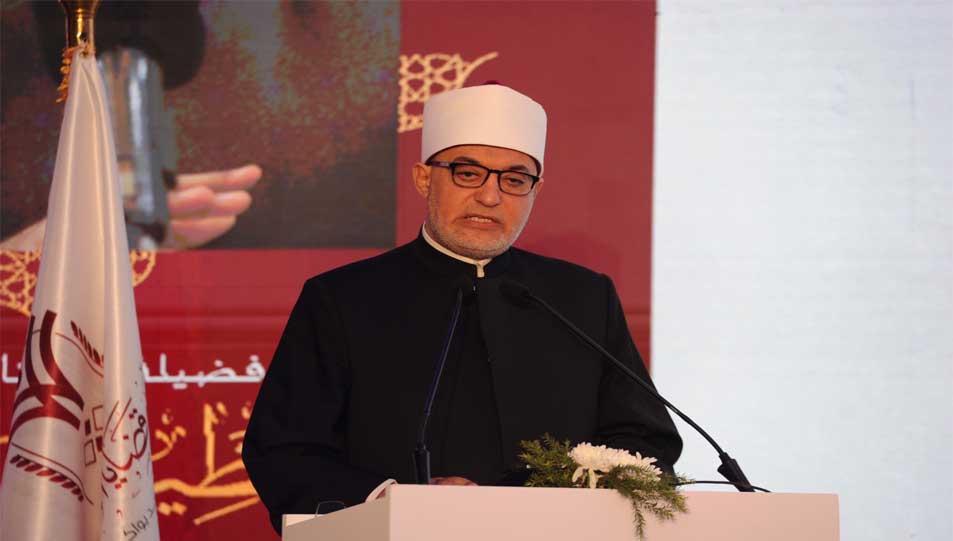
His Eminence Dr. Nazir Mohammad Ayyad, Grand Mufti of Egypt and President of the General Secretariat for Fatwa Authorities Worldwide, inaugurated the Second International Symposium under the theme: “Fatwa and Contemporary Human Issues: Toward Sound Ijtihād that Responds to Contemporary Challenges”, held under the umbrella of Egypt’s Dar Al-Ifta.
The Grand Mufti highlighted that sound fatwa serves as a safeguard for societies amid crises and rapid transformations. He emphasized that fatwa is not merely an intellectual exercise but a vital tool for guidance, social stability, and public well-being.
He stressed the growing importance of responsible digital fatwa in the era of digital globalization, as a means to enhance awareness, protect value-based identity, and foster critical and creative thinking among younger generations. Fatwa, he noted, is the voice of mercy, the mind of wisdom, and an instrument for societal guidance and justice.
He concluded that the symposium marks a significant step in promoting sound ijtihād, strengthening the role of scholars, and fostering informed, conscientious public awareness to face the challenges of the modern age.
The Full Speech
In the Name of Allah, the Most Merciful, the Compassionate
All praise is due to Allah, Lord of the worlds. May Allah’s blessings, peace, and grace be upon our Master and Prophet Muhammad, his family and Companions.
Distinguished guests,
May Allah’s peace, mercy and blessings be upon you.
I begin by expressing my sincere gratitude to all of you for participating in this Second International Symposium of the General Secretariat for Fatwa Authorities Worldwide, held under the theme: “Fatwa and Contemporary Human Issues: Toward Sound Ijtihād that Responds to Contemporary Challenges.” This symposium is convened under the patronage of His Excellency President Abdel Fattah El-Sisi, may Allah protect and preserve him. We ask Allah Almighty to bless our efforts with success and guidance.
This profound theme reminds us of the strong foundations in the formulation and practice of fatwa and of the meaningful outcomes that flow from it—outcomes that are fruitful, not barren.
Let us reflect on the Qur’an, this infallible Book, which is high above falsehood, to draw from it a methodology closely linked to our theme: the methodology of “They ask you (O Prophet)” (yas’alūnaka). This approach safeguards human beings in all aspects: spirit, intellect, heart, knowledge, action, worldly life, and Hereafter, as well as relationships with self and society.
In the Qur’an, “They ask you” addresses fundamental questions: the secret of life, the soul, the Hereafter, historical lessons, and moral guidance, illustrating the intimate link between fatwa and reality, guiding human conduct within its context.
The Qur’an was revealed gradually in response to unfolding events and emerging questions. Scholars note that this gradual revelation revealed a remarkable harmony with human reality and understanding of people’s needs. When disbelievers questioned this approach, Allah responded: “Thus [it is revealed] that We may strengthen your heart thereby, and We have recited it in measured recitation” [Qur’an 35: 32]. This demonstrates the Qur’an’s alignment with life’s realities and human circumstances.
Inspired by this methodology, this symposium affirms that fatwa is not issued in isolation, nor detached from context. Rather, it is a scholarly discipline, grounded in authentic evidence, guided by higher objectives (maqāṣid), mindful of consequences, and responsive to contemporary challenges.
To this effect, Egypt’s Dar Al-Ifta has established a balanced ijtihād-based methodology that bridges constants and variables, preserves human dignity, and helps individuals navigate complex realities, ranging from family and social issues to digital transformations and questions of ethics and identity.
Our gathering today reflects this effort, which aims to provide a sound religious discourse that combines wisdom with jurisprudential insight and contributes to building a conscious, resilient society.
Distinguished audience,
Our world faces not just isolated crises but deep human turmoil—wars, accelerating disasters, and economic, health, and environmental challenges that threaten security and stability.
In this context, institutional fatwa assumes critical importance. Fatwa is no longer merely an individual response; it has become a safety valve that safeguards lives, protects society, and guides public awareness toward moderation and sound judgment.
Therefore, Egypt’s Dar Al-Ifta recognized early the gravity of global transformations, establishing procedural guidelines for emergency fatwas. This transforms fatwa from a legal opinion into a practical tool supporting decision-makers and state programs, especially in health, social, and developmental matters.
During the COVID-19 pandemic, Dar Al-Ifta pioneered precise juristic adaptation, combining respect for modern science with Sharia objectives. Its fatwas helped calm fears, prevent chaos, preserve lives, and protect societal security. This institutional methodology also curtailed the spread of non-specialist fatwas that threaten social stability and public awareness.
Dar Al-Ifta has also addressed the Palestinian cause through a firm institutional fatwa discourse that safeguards religious awareness, avoids political or emotional exploitation, and guides responsible engagement. Gaza, undoubtedly, has remained a priority: fatwas protect the land, uphold its belonging to the Ummah, resist displacement, expose crimes, and encourage humanitarian support.
Key measures include:
Affirming the justice of the Palestinian cause and the legitimacy of its people’s rights.
Debunking false narratives that misrepresent religion or distort awareness.
Rationalizing solidarity by regulating legal rulings and preventing impulsive fatwas that may undermine Shari’ah objectives.
Through these approaches, fatwa evolves into a cognitive and awareness-building tool that shapes disciplined public consciousness, supports just causes, protects human rights, preserves Sharia objectives, and strengthens regional stability.
In today’s digital era, sound digital fatwa is essential. It is not merely a technical skill but a framework for guiding awareness, critical thinking, and engagement with digital content, while preserving values and identity.
Digital fatwa strengthens value-based identity, integrating moral values, intellectual knowledge, emotional belonging, and practical conduct—helping individuals navigate change while maintaining their essence and identity. It equips generations to interact confidently with the digital age while protecting them from identity alienation and uncritical conformity.
This balance cultivates active, creative citizens capable of building a nation that harmonizes authenticity with modernity, constants with innovation, and heritage with contemporary openness.
In this context, cultural selfhood becomes a reference shaping identity, values, and behavior, answering: Who am I? What do I believe in? What principles guide my choices? Fatwa guides this integration, turning identity into a living, active force that fosters self-confidence, stability in decision-making, and resilience in confronting modern challenges.
Distinguished audience,
Current global events demand that fatwa institutions be deeply attuned to reality, engaged in intellectual and media arenas, and connected to human needs and suffering. Fatwa is not a luxury or theory; it is a mission of rescue in crises and a responsibility of reconstruction in shaping human consciousness.
Contemporary fatwa must actively engage in issues such as armed conflicts, protection of civilians, access to education and healthcare, alleviating poverty, and removing obstacles to development. Fatwa is a voice of mercy, the mind of wisdom, and a regulatory instrument guiding society, alleviating suffering, promoting justice, and reinforcing solidarity and coexistence.
We pray that this symposium marks a new step toward sound ijtihād, blesses the efforts of scholars, and benefits nations and people.
Thank you for your kind attention.
May Allah’s peace and blessings be upon you.
Dr. Nazir Muhammad Ayyad
Grand Mufti of the Arab Republic of Egypt
President of the General Secretariat for Fatwa Authorities Worldwide