Arabic
 French
 Deutsch
 Urdu
Urdu Pashto
 Swahili
 Hausa
Hausa

Egypt’s Grand Mufti Unveils Outcomes of the Second International Symposium on Fatwa and Human Realities
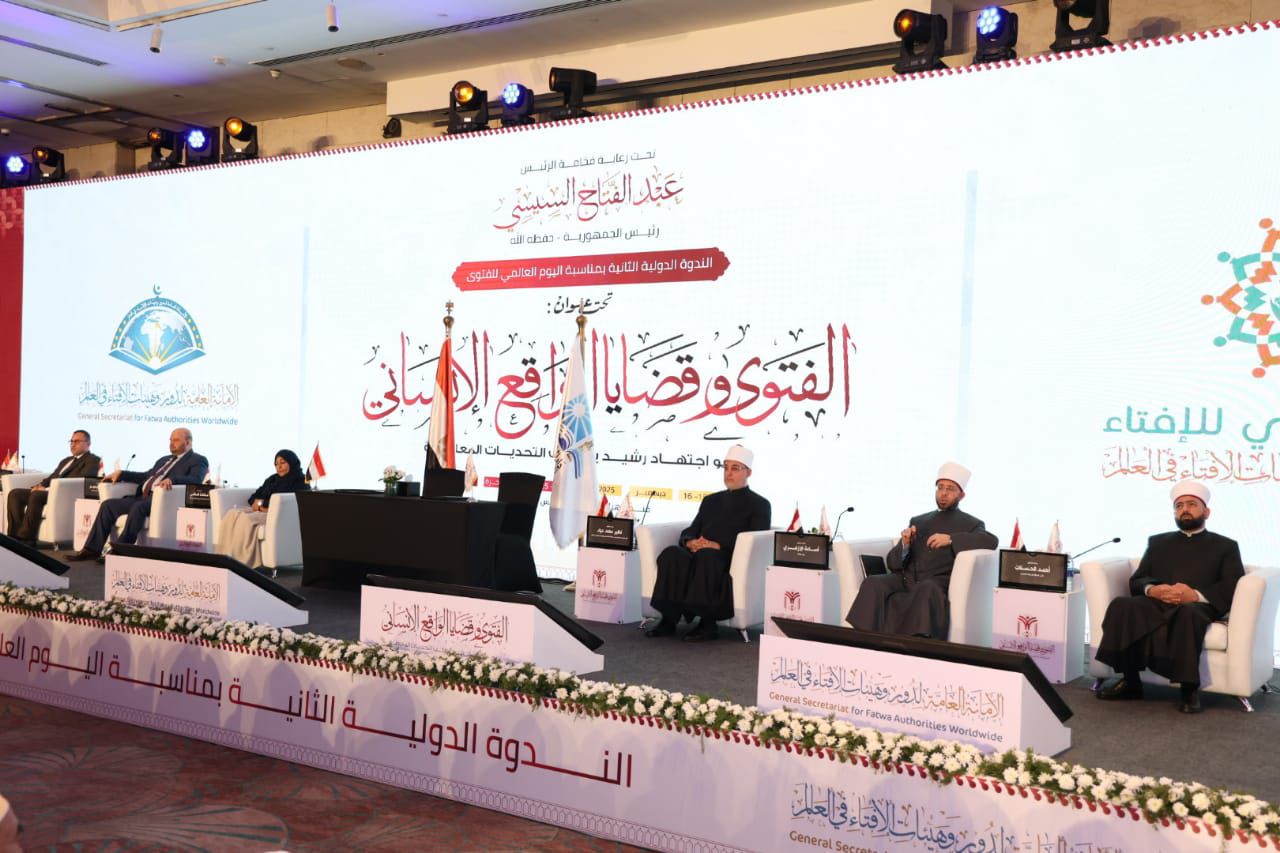
Egypt’s Grand Mufti has unveiled the outcomes of the Second International Symposium of the General Secretariat for Fatwa Authorities Worldwide, held in Cairo on 15–16 December 2025 under the patronage of President Abdel Fattah El-Sisi. The symposium brought together leading Muftis, scholars, and experts from around the world to examine contemporary human and social challenges and the pivotal role of fatwa in upholding justice, human dignity, and ethical guidance. The Mufti highlighted the symposium’s key recommendations, emphasizing the importance of principled religious guidance, international cooperation, and the promotion of a balanced, culturally aware, and forward-looking discourse.
Read full statement
Final Statement of the Second International Symposium
of the General Secretariat for Fatwa Authorities Worldwide
and Egypt’s Dar Al-Ifta
All praise be to Allah, Lord of the Worlds, and peace and blessings be upon the one sent as a mercy to all worlds, our master Muhammad, and upon his family and Companions.
Esteemed attendees,
May Allah’s peace, mercy and blessings be upon you.
At the conclusion of the proceedings of the Second International Symposium of the General Secretariat for Fatwa Authorities Worldwide, held in Cairo in December 2025 under the title “Fatwa and Contemporary Human Issues: Toward Sound Juristic Reasoning that Keeps Pace with Contemporary Challenges,” the participants issue this final statement in their name and in the name of the organizing institutions.
This symposium was convened as an affirmation of the importance of the subject of fatwa and humanitarian issues in a world witnessing an escalation of unprecedented challenges, including crises, armed conflicts, natural disasters, and global pandemics, and the urgent issues they impose, which require sound juristic reasoning that comprehends contemporary developments with wisdom and insight.
The symposium was held with broad participation from muftis, scholars, and representatives of fatwa institutions from various countries around the world, alongside experts in humanitarian and human rights fields, with the aim of exchanging perspectives and enhancing coordination regarding the role of fatwa institutions in safeguarding human dignity and addressing contemporary issues with a responsible spirit and through international cooperation.
After extensive discussions, the participants affirmed the following:
Main Themes Discussed by the Symposium
Fatwa and Human Dignity
This theme addressed the Shari’ah and ethical foundations that necessitate the preservation of human dignity and the observance of human rights and duties within the fatwa process. It emphasized the necessity that every fatwa be issued in a manner that respects human rights and human inviolability, and safeguards reputation and privacy.
Fatwas on Crises and Extraordinary Situations
This theme reviewed the role of fatwa institutions in addressing extraordinary situations and emergency crises in a manner that combines openness to lived reality with adherence to established principles.
Contemporary Juristic Reasoning on Humanitarian Issues
This theme addressed several issues, including migrants, refugees, victims of wars, as well as issues of poverty, development, climate change, and others.
International Cooperation and Institutional Openness
This theme addressed the importance of strengthening cooperation among fatwa institutions worldwide and with other diverse scientific institutions.
Joint Applied Workshops
Interactive workshops were held with the participation of muftis and specialists in humanitarian work, resulting in preliminary plans for joint projects between fatwa institutions and relief and human rights organizations.
Key Results and Outputs of the Symposium
“Charter of Fatwa and Human Dignity”
An ethical document that establishes the Sharia-based and professional principles and values to which fatwa institutions commit themselves, with the aim of safeguarding human dignity while taking into account the cultural and social particularities of peoples, without compromising the constants of the tolerant Islamic Shari’ah.
“Procedural Guide for Fatwas on Crises and Extraordinary Situations”
A unified practical guide to be used by muftis and fatwa institutions during major crises and in the issuance of fatwas under exceptional circumstances.
“Guide to Contemporary Fatwas on Humanitarian Issues”
An expanded publication that includes studies and contemporary fatwas on the most prominent humanitarian issues in our world, combining authenticity with contemporaneity.
Executive and Applied Initiatives
“AI Fatwa”
A fatwa model developed by the Egyptian Dar al-Iftaa and one of the most important outputs of the Secretariat’s symposium. It uses artificial intelligence to analyze questions and provide precise Sharia rulings, representing a qualitative shift in the development of the fatwa system and the strengthening of its presence. This model has been established.
Fatwa for Humanity Platform
The establishment of a global, multilingual digital platform under the supervision of the General Secretariat, bringing together fatwa institutions and enabling the exchange of expertise and juristic reasoning among muftis. The platform may provide a smart application that interacts with urgent questions and delivers rapid and reliable responses.
Global Developmental Fatwa Bank
A centralized digital database that compiles accredited fatwas issued on developmental and humanitarian issues from various fatwa institutions. The bank serves as a global reference for best fatwa practices, and it has been established and completed.
Outcomes of the Joint Workshops
These outcomes included proposed projects and training programs to enhance the capacities of muftis, mechanisms for establishing an international communication network between fatwa institutions and relief organizations to enable immediate information exchange during crises, and the launch of joint electronic platforms to disseminate humanitarian fatwas in multiple languages.
Partnership Program between Fatwa Institutions and Ministries of Health
The launch of the “Medical Sharia Consultant” initiative, whereby Sharia consultants are present in major hospitals.
Final Recommendations and Calls
1. Adoption of the symposium’s outputs and their implementation within fatwa institutions worldwide, and their integration into institutional practices and training curricula.
2. Commitment to international humanitarian law and the protection of civilians during wars and conflicts, condemnation of crimes and violations committed against the defenseless Palestinian people, and a call upon the international community to take immediate action to stop the bloodshed, ensure the delivery of aid, and protect the rights of the oppressed.
3. The symposium reaffirms its full support for the steadfastness of the people of Gaza in particular, and the Palestinian people in general, against the ongoing aggression they face. It emphasizes their legitimate rights, guaranteed under international law and conventions, to defend their land and holy sites, and rejects all attempts at displacement or erasure of their identity. The symposium also highlights the Palestinian people’s commitment to their just cause, recognizing it as a historical and human right that does not lapse with time, and calls upon the international community to fulfill its moral and legal responsibilities to end the aggression, protect civilians, and uphold the legitimate rights of the Palestinian people.
4. Egypt’s religious institution, represented by its three pillars—the Al-Azhar Al-Sharif, the Ministry of Awqaf, and Dar al-Ifta—reaffirms its full support for Egypt’s steadfast and unwavering position on the Palestinian issue. It underscores the inalienable and legitimate right of the Palestinian people to establish an independent state with full sovereignty over their occupied territories, with Jerusalem as its capital. The institution emphasizes that this position is grounded in historical, national, and moral principles, and is firmly based on the principles of international justice and relevant international resolutions, safeguarding the Palestinian people’s legitimate historical rights.
5. Strengthening international solidarity in confronting shared issues, such as poverty and pandemics.
6. Affirming institutional integration among fatwa institutions worldwide under the umbrella of the General Secretariat through the exchange of expertise, unification of working mechanisms, and activation of international fatwa initiatives, including the document on fatwa cooperation and integration.
7. Investing technology to expand the global reach of fatwa services, and launching smart applications and multilingual interactive platforms.
8. Valuing the role of religious diplomacy in supporting global peace efforts, promoting the values of coexistence, and strengthening sound identity.
9. Strengthening cooperation between the ministries of education, culture, and media and fatwa institutions to incorporate concepts of tolerance, coexistence, and intellectual security into educational curricula, and to develop media initiatives that address segments of society, especially youth, in order to protect emerging generations from the scourges of ignorance and extremism.
10. Strengthening ties between fatwa institutions and health authorities to ensure the issuance of unified and sound medical fatwas, particularly during pandemics and health crises.
11. Taking developmental objectives into account in the fatwa process, and directing fatwas to support poverty alleviation, improvement of education and healthcare quality, and environmental protection.
12. Continuing firm efforts to confront intellectual extremism and aberrant fatwas that undermine societal stability, and enhancing coordination among religious, security, educational, and media institutions to correct misconceptions among youth.
13. The need for active engagement with real-world issues, going beyond theoretical discourse to adopt concrete, practical, and implementable measures, while emphasizing that fatwa discourse must be clear, firm, and unambiguous in affirming that aggression against innocent and peaceful people is a grave crime that does not lapse with time, in order to uphold human dignity and safeguard the security of societies.
In conclusion, we ask Allah Almighty to grant us success in all that leads to goodness and guidance, to make our fatwas a source of guidance for humanity and a light that dispels the darkness of ignorance and extremism, to unite our Ummah upon truth, to bring harmony to the hearts of its people, and to relieve humanity of wars and conflicts.
Finally, in my name and in yours, I extend sincere thanks and appreciation to His Excellency President Abdel Fattah El-Sisi for his gracious patronage and continuous support of the activities of the Egyptian Dar al-Iftaa and the General Secretariat. We ask Allah to grant him care and protection.
Thanks are also extended to all my colleagues, brothers, sons, and daughters at the Egyptian Dar al-Iftaa and the General Secretariat for the efforts they exerted and the work they carried out. May Allah reward them all generously.
And to the esteemed attendees, and to media professionals and journalists, partners in success in every event and gathering, may Allah reward you with goodness.
Peace be upon you, and the mercy and blessings of Allah.