Arabic
 French
 Deutsch
 Urdu
Urdu Pashto
 Swahili
 Hausa
Hausa

Receiving Ramadan: Spirituality in the Age of AI
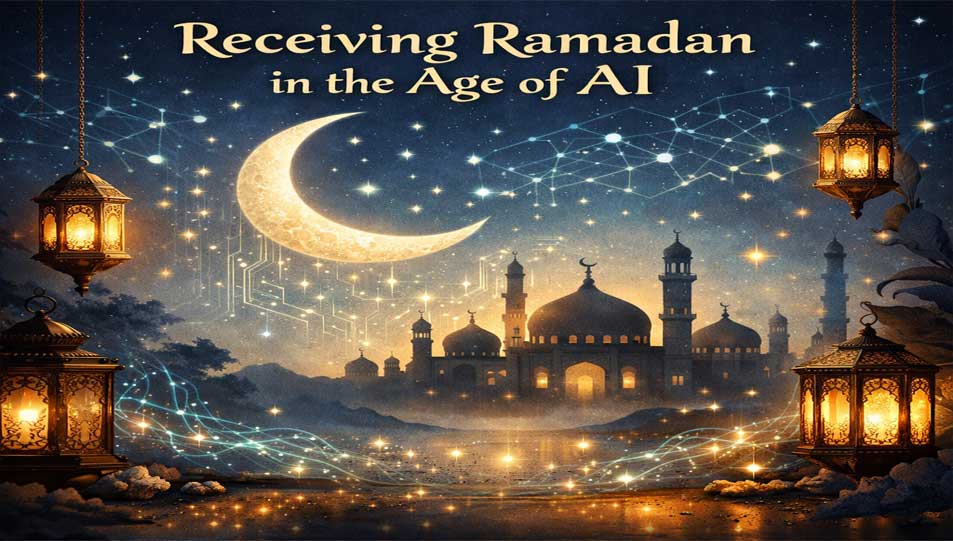
Ramadan, the blessed month of fasting, reflection, and spiritual renewal, occupies a central place in the life of every Muslim. Fasting is the fourth pillar of Islam and Ramada’s arrival is far more than a calendar event; it is a spiritual invitation to purify the heart, strengthen faith, and renew one’s relationship with Allah. The Qur’an emphasizes the sacredness of this month as per the words of Allah Almighty: “The month of Ramadan [is that] in which was revealed the Qur’an, a guidance for the people and clear proofs of guidance and criterion…” (Qur’an 2:185).
This verse reminds us that the significance of Ramadan extends beyond abstaining from food and drink; it is an opportunity to immerse oneself in the Qur’an and cultivate a life of good deeds.
The Sunnah of Prophet Muhammad (peace and blessings be upon him) provides clear guidance on how to receive Ramadan in the most spiritually rewarding way. One of the key practices highlighted in Islamic tradition is the performance of good deeds and acts of worship during the month preceding Ramadan, Sha‘ban. Lady ‘Aishah (may Allah be pleased with her) reported: “I never saw the Messenger of Allah (peace and blessings be upon him) fast more than he did in Sha‘ban” (Bukhari).
Scholars explain that this practice was not intended to earn the reward of Sha‘ban alone, but to prepare the soul for the forthcoming month of Ramadan. Engaging in voluntary fasting, extra prayers, and other acts of devotion during Sha‘ban conditions the heart to embrace the rigorous yet spiritually enriching fast of Ramadan. Ibn Rajab al-Hanbali (d. 795 A.H.) emphasizes that such pre-Ramadan preparation disciplines the soul and fosters continuity in worship, building the spiritual resilience necessary to maximize the blessings of the month.
Equally essential is the purification of the heart through sincere repentance and duʿā’ (supplication). The Prophet (peace and blessings be upon him) reminded his Companions of the weight of fasting, stating: “The first thing that Allah will take account of from the deeds of His servant on the Day of Resurrection will be fasting” (At-Tirmidhi).
This hadith illustrates that the spiritual value of one’s fast is intimately connected to the inner state of the worshipper. Scholars such as Imam al-Ghazzali, in Ihya’ Ulum al-Din, note that a heart burdened with sins diminishes the impact of fasting. Therefore, seeking forgiveness, performing good deeds in Sha‘ban, and making earnest supplications to Allah are critical steps in entering Ramadan with a purified heart and heightened spiritual awareness.
Preparing for Ramadan also involves deliberate engagement with the Qur’an. The Prophet (peace and blessings be upon him) encouraged reflection and recitation, particularly as Ramadan approached, ensuring that believers enter the month ready to absorb its guidance, rather than merely abstaining from worldly pleasures. Imam Nawawi (d. 676 A.H.) recommended that students review texts concerning Ramadan a week prior to its arrival to understand its virtues and obligations. Such preparation equips the believer not only physically, but also mentally and spiritually, allowing for a more profound engagement with the transformative potential of the month.
The pursuit of the Night of Qadr, which is described in the Qur’an as “better than a thousand months” (Qur’an 97:3), is another critical aspect of preparation. The Prophet (peace and blessings be upon him) instructed his Companions to seek this night during the last ten nights of Ramadan, particularly on the odd-numbered nights (Bukhari). Classical scholars note that the discipline and good deeds practiced in Sha‘ban cultivate the patience, devotion, and spiritual readiness necessary to fully benefit from these sacred nights, which are marked by intense worship and reflection.
Ramadan in the Age of AI
In today’s age, technology and Artificial Intelligence (AI) offer tools that can enhance preparation for Ramadan. Digital Qur’an reciters, AI-based reminders for prayer, and guided study applications can support consistent worship and Qur’anic engagement. However, such tools must not replace sincere personal devotion or the inward transformation that Ramadan seeks to foster. According to Islamic law, artificial intelligence cannot serve as a primary source for acquiring Islamic knowledge or replace qualified scholars. Religious learning requires engagement with specialists to ensure accurate understanding and mastery of legal methodology, as automated tools cannot reliably distinguish between strong and weak scholarly opinions or bear responsibility for issuing legal rulings (fatwas).
Nevertheless, AI can be used responsibly as a supportive tool for gathering information, organizing topics, or identifying relevant sources provided that all material is verified by qualified scholars or authoritative references. Sound Islamic learning must remain grounded in traditional scholarship, with technology employed only as a supplementary aid.
In light of these insights, receiving Ramadan according to the Sunnah involves holistic preparation: purifying the heart through repentance, increasing good deeds in Sha‘ban, engaging deeply with the Qur’an, making sincere duʿā’, and nurturing the intention to seek the Night of Qadr. Performing good deeds in Sha‘ban is not merely a recommendation; it is a prophetic strategy for entering Ramadan with spiritual momentum, ensuring that fasting and worship are meaningful and transformative. In the age of AI, modern tools can enhance this preparation, yet the essence remains firmly rooted in the timeless guidance of the Qur’an and the Sunnah. The greatest preparation, as always, lies in cultivating sincerity, discipline, and devotion within the heart.