Arabic
 French
 Deutsch
 Urdu
Urdu Pashto
 Swahili
 Hausa
Hausa

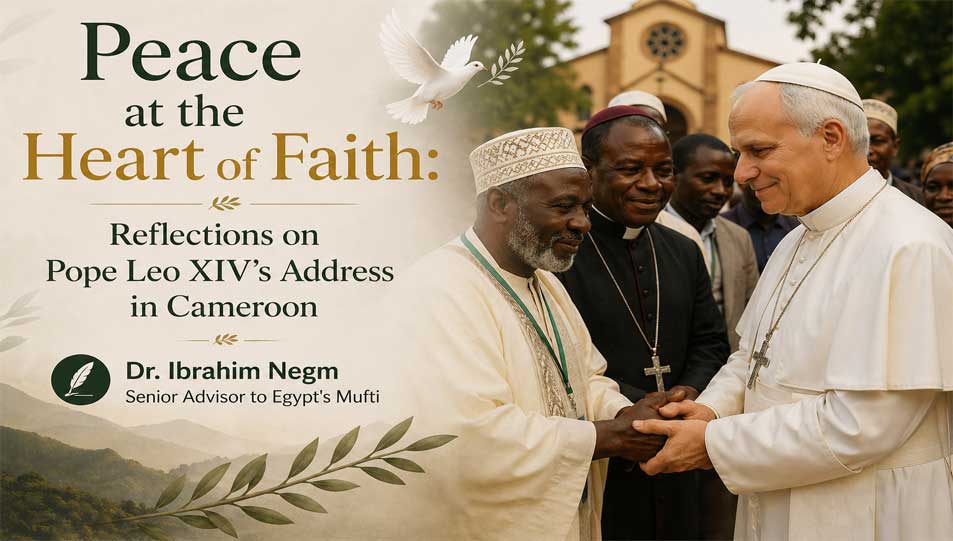
Peace at the Heart of Faith: Reflections on Pope Leo XIV’s Address in Cameroon
Dr. Ibrahim Negm
Senior Advisor to Egypt’s Mufti,
Secretary General, Fatwa Authorities Worldwide
On April 16, 2026, Pope Leo XIV stood in St. Joseph’s Cathedral in Bamenda, a Cameroonian city that has endured a brutal conflict since 2017. There, among victims and survivors, and in the presence of imams, clergy, and community leaders gathered around him, he delivered words that cut through the moment with moral clarity:
“Blessed are the peacemakers! But woe to those who exploit religion and the name of God to achieve their military, economic, or political gains, casting what is sacred into darkness and mire.”
These were not ceremonial remarks, nor diplomatic pleasantries meant to soothe consciences in private while remaining unspoken in public. They were testimony, offered before God and history, at a moment when Christians, Muslims, and ordinary people alike share the same wound.
The phenomenon the Pope warned against is neither new nor confined to a particular religion or geography. It is a recurring human failing: the instrumentalization of religious discourse to mask the pursuit of power and wealth. Across history, religious scholars and thinkers have cautioned against this distortion—against turning religion from a message of salvation into a tool of domination.
In the specific context of Cameroon, the Pope’s words exposed a familiar mechanism: those who plunder the land’s resources reinvest their profits in weapons, sustaining an endless cycle of destruction and death, while cloaking it all in a veneer of false sanctity. He described this starkly as: “an upside-down world that must be rejected.”
What emerges with painful clarity is that religion can be hijacked, and that the true architects of war often excel at dressing their bullets in divine language.
A striking feature of the Bamenda gathering was its inclusivity. The Pope did not address Catholic clergy alone; he spoke before a Muslim imam, Christian leaders, and traditional authorities seated side by side. He himself observed that:
“the crisis shaking these regions has brought Christian and Muslim communities closer than ever before.” As one speaker at the meeting noted: “Suffering knows no religion, race, language, or color.”
This is a point that religious institutions must take seriously. When people are united in suffering, the sectarian masks crafted by those who exploit religion fall away, revealing a shared truth: at its core, religion is a message of mercy and peace, not a license to absolve the crimes of the powerful.
In Islam, clear texts prohibit the misuse of religious rites to legitimize aggression and injustice. Jihad is governed by strict ethical constraints, and issuing a fatwa is a trust that cannot be commodified. The Pope’s words thus serve not as an indictment of one religion over another, but as a reminder of a shared moral responsibility borne by all authentic religious leadership.
One of the Pope’s most striking observations was: “The lords of war ignore that destruction happens in a moment, while rebuilding takes generations.”
He has also emphasized in earlier addresses, including his message for the World Day of Peace, that global military spending reached approximately $2.7 trillion in 2024, about 2.5% of global GDP, while funding for education, healthcare, and reconstruction remains insufficient.
To this effect, deploying religion to justify violence becomes a double crime: against the human being who is killed or displaced, and against religion itself, which is distorted and stripped of its moral authority in the eyes of future generations. When young people see religion used to embellish war and legitimize exploitation, they turn away from it. This helps explain the Pope’s concern that faith is increasingly perceived in some circles as “absurd.”
The Bamenda scene signifies that the role of a religious leader is not safe silence, nor retreat into private devotion. The Pope went directly to the heart of the conflict and spoke candidly, even in the presence of Cameroon’s president, calling on the government to confront corruption and resist “the whims of the wealthy and the powerful.”
This is the model: a religious leader who bears witness to his time, speaks truth when it is costly, and safeguards the sacred from degradation. Silence in the face of those who cloak war in verses, hadiths, and religious teachings is not neutrality; it is complicity. Religious institutions that turn a deaf ear to such distortions risk becoming, through silence, participants in the cycle of destruction.
Pope Leo XIV came to Cameroon proclaiming peace, only to find communities teaching it to him through their resilience and solidarity despite deep wounds. This paradox offers a profound lesson: true religion is not measured by the number of sermons or the volume of voices, but by the peace it cultivates in lived reality and the humanity it preserves in times of brutality.
In Egypt, from the vantage point of a longstanding religious institution that combines scholarly tradition with social responsibility, we recognize that confronting the exploitation of religion for political, military, and economic ends is not the concern of one faith alone, it is a shared human duty. When killing is adorned with scripture, theft justified by fatwa, and injustice sanctified by consensus, we are facing a deep civilizational rupture that demands vigilance, intellectual clarity, and a courageous religious voice, one that does not fear wealth or power.
Religion is a trust entrusted by God to His servants to build life, not to justify its destruction.