Arabic
 French
 Deutsch
 Urdu
Urdu Pashto
 Swahili
 Hausa
Hausa

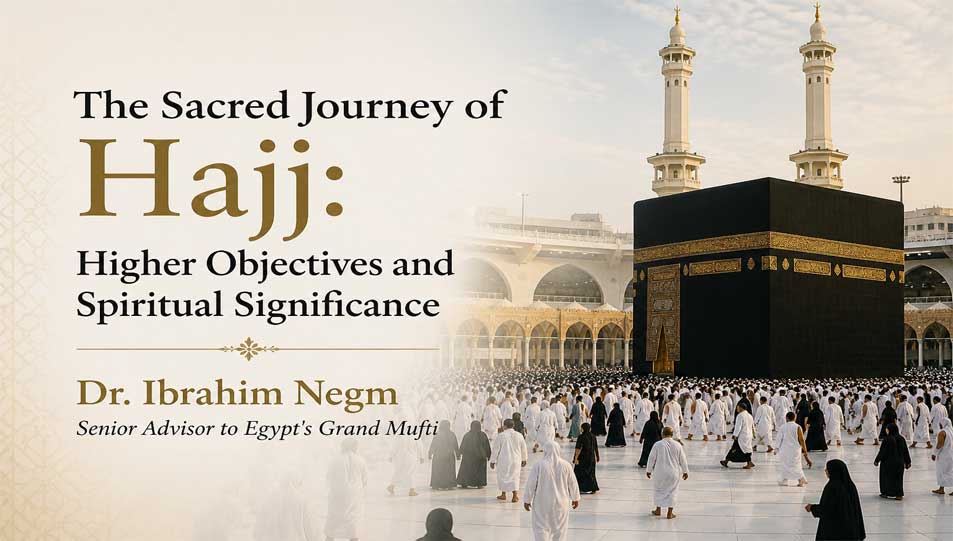
The Sacred Journey of Hajj: Higher Objectives and Spiritual Significance
Introduction
Every year millions of Muslims from every part of the world leave their homes and travel to Mecca to fulfil the fifth pillar of Islam. They come from different regions, cultures and economic backgrounds yet, in front of the Kaʿbah, they become one community. This gathering is more than a ritual obligation; it is a deeply spiritual journey that showcases the essence of Islam. The Qur’an commands, “Pilgrimage to this House is an obligation by Allah upon whoever is able among the people” (Qur’an 3: 97), establishing the pilgrimage as a duty once in a lifetime for those who can afford it. The Hajj calls believers to detach from worldly distractions, renew their faith and engage in an intense form of worship that touches their hearts and reshapes their lives.
This feature story explores the higher objectives (maqāṣid) and spiritual significance of Hajj for English‑speaking Muslims. Drawing on scriptural sources, Prophetic tradition and contemporary scholarship, it explains how each element of Hajj contributes to moral growth, social unity and devotion to God. It also reflects on the psychological and social benefits of this sacred journey and considers its relevance in the modern world. The purpose is not only to inform but to inspire believers to internalize the lessons of Hajj and live them beyond the sacred days.
Historical Origins and Scriptural Foundations
Prophetic heritage and Qur’anic mandate
Hajj traces its origins to the story of the Prophet Ibrāhīm (Abraham) and his family. When Ibrāhīm completed the building of the Kaʿbah, he was commanded to call humanity to the pilgrimage. In the Qur’an Allah says: “And proclaim to the people Hajj [the pilgrimage]; they will come to you on foot and on every lean camel; they will come from every distant pass” (Qur’an 22: 27). Ibrāhīm wondered how his voice would reach the world, but God conveyed his proclamation to all of humanity, and people respond to this call even today.
The Qur’an also states that the pilgrimage was prescribed only for those who are physically and financially able. The verse in Sūrat Āl ʿImrān summarises the obligation: “Pilgrimage to this House is an obligation by Allah upon whoever is able among the people”. The pilgrimage is therefore an act of devotion grounded in divine command rather than a mere cultural tradition.
Timing and rituals in scripture
The Qur’an describes Hajj as taking place in specific months. Pilgrims are prohibited from quarrelling and indecent behaviour; instead they are encouraged to remember God and take provisions for the journey, for “the best of provisions is piety”. Another verse notes that sacrifices during Hajj are accepted not for their flesh or blood but because they reflect the pilgrim’s piety. These injunctions highlight that the rituals themselves are symbolic acts whose value lies in the moral and spiritual attitude of the pilgrim.
Prophet Muhammad (peace and blessings be upon him) made Hajj obligatory for his followers in the ninth year after his emigration to Medina. Abu Huraira narrated that he heard the Prophet (PBUH) say, “Whoever performs Hajj for Allah’s pleasure and does not have sexual relations with his wife, and does not do evil or sins then he will return (after Hajj free from all sins) as if he were born anew”. This Prophetic teaching underscores the spiritual cleansing associated with an accepted Hajj. Another hadith reports that an accepted Hajj has no reward except Paradise, illustrating the enormous merit of performing the rites sincerely.
Early practice of the community
The first major Hajj led by Prophet Muhammad was his Farewell Pilgrimage. During this Hajj he delivered his final sermon on the plain of ʿArafah, emphasising the sanctity of human life, property and honor, and declaring that no Arab is superior over a non‑Arab and no white person over a black person except by piety. He reminded the community of their collective responsibility and commanded them to convey his message to those not present. This sermon remains a foundational declaration of human equality and social justice within Islam.
The rituals of Hajj and their symbolism
Hajj consists of a series of rituals that follow the legacy of Ibrāhīm and his family. Each rite has profound meaning, linking the pilgrim to sacred history and conveying moral lessons. A brief overview of the main rites and their symbolic significance appears below.
Intention, preparation and ihrām
Before departing for Mecca, the pilgrim forms the intention (niyyah) to perform Hajj solely for the sake of God. Once at a miqāt (designated boundary), the pilgrim enters a state of ritual sanctity known as ihrām. Men wear two unstitched white cloths and women adopt simple modest attire. This uniform appearance strips away worldly distinctions; the rich and the poor, the ruler and the servant all wear similar garments. Ihrām garments for men resemble the shroud in which people are buried, reminding pilgrims of death and equality. It creates a sense of humility and equality before God, reinforcing the idea that piety, not social status, is what matters.
In ihram, the pilgrim must avoid quarrelling, hunting, cutting hair or nails, and marital relations. These restrictions teach self‑restraint and discipline, emphasising the need to control desires for a higher purpose. Pilgrims continuously recite the talbiyah: “Labbayk Allahumma labbayk – Here I am, O Allah, here I am”. The chant declares one’s readiness to obey God’s call, renews the commitment to monotheism and symbolises the unity of humanity gathered for worship.
Ṭawāf (circumambulation of the Kaʿbah)
Upon arrival in Mecca, pilgrims perform Ṭawāf al‑Qudūm (the arrival circumambulation) by walking seven times around the Kaʿbah. This ancient house is the first place of worship built for humanity. The circular movement symbolises the continuous remembrance of God and the harmony of creation. Pilgrims may kiss or touch the Black Stone (ḥajar al‑aswad) following the practice of the Prophet. The Companion ʿUmar said he kissed the stone because he saw the Prophet does so, acknowledging that it is an act of obedience rather than a source of benefit. This teaches submission to divine commands even when one cannot fully grasp their wisdom.
Saʿy between Ṣafā and Marwah
After ṭawāf, pilgrims perform saʿy, running seven times between the small hills of Ṣafā and Marwah. This reenacts the desperation of Hājar (Hagar), who ran between these hills searching for water for her infant son Ismāʿīl. God rewarded her patience by causing a spring (the Well of Zamzam) to gush forth. Saʿy thus symbolises striving and trust in divine providence; it reminds pilgrims that relief comes from God even when all efforts seem exhausted. Millions of men and women imitate Hājar’s footsteps each year, underscoring the significant role of a woman in Islamic history.
Standing at ʿArafah
The 9th of Dhul Ḥijjah is Yawm ʿArafah, the climax of Hajj or the main pillar of Hajj. Pilgrims stand on the plain of ʿArafah from noon until sunset, supplicating and seeking forgiveness. The Prophet described it as the essence of Hajj, saying “Hajj is ʿArafah”. Here he delivered his final sermon and emphasised equality and social justice. The stand at ʿArafah mirrors the gathering on the Day of Judgement when all people will stand before God, stripped of worldly attachments. The crowds of diverse peoples remind pilgrims of resurrection; as an article on the spiritual journey notes, the gathering of people in Mecca resembles the resurrection and the day of judgement. Pilgrims spend the day begging for forgiveness, and tears often flow as they recognise their dependence on divine mercy.
Muzdalifah and gathering pebbles
After sunset on ʿArafah, pilgrims move to Muzdalifah, an open plain where they pray, rest and collect small pebbles. Spending the night under the open sky reminds them of human vulnerability and fosters gratitude. The pebbles will be used for the ritual stoning of the devil (ramī al‑jamārāt) in Mina.
Mina and the stoning of the Jamarāt
Over the next three days, pilgrims stay in Mina and perform the ramī by throwing pebbles at three stone pillars that symbolise the devil. This ritual commemorates Ibrāhīm’s rejection of Satan’s temptations when he was commanded to sacrifice his son Ismāʿīl. The act of throwing pebbles symbolises the pilgrim’s rejection of evil inclinations and the resolve to abandon bad habits. An article explains that with each pebble, the pilgrim symbolically throws away a bad habit.
Sacrifice and ‘Eid al‑Adhā
After the first stoning, pilgrims offer a sacrificial animal. The sacrifice commemorates the moment when God substituted a ram for Ibrāhīm’s son, highlighting God’s mercy and the importance of obedience. The Qur’an emphasises that it is not the meat or blood that reaches God but the piety of the pilgrim. Pilgrims distribute the meat to the poor, reinforcing charity and gratitude.
Shaving or cutting hair and farewell ṭawāf
Pilgrims then shave or trim their hair, marking a new beginning free of past sins. They perform Ṭawāf al‑Ifāḍah (or ṭawāf al‑ziyārah), another circumambulation of the Kaʿbah, which completes the major rites of Hajj. Before leaving Mecca, pilgrims perform a farewell ṭawāf (Tawāf al‑Widaʿ), showing respect to the sacred sanctuary.
Higher Objectives (Maqāṣid) of Hajj
Islamic scholars have reflected on the deeper objectives of Hajj beyond the outward rites. These maqāṣid include strengthening faith, remembering the sacrifices of the early Muslims, fostering unity and equality, disciplining the self and instilling universal moral values. The following subsections explore these objectives with references to scriptural evidence and scholarly analysis.
Deepening faith and cultivating piety
Performing Hajj as prescribed strengthens faith and cleanses the soul. Pilgrims live for days in places where revelation was sent, renewing their commitment to adhere to God’s commands and prohibitions. The pilgrimage environment, filled with recitation of Qur’an and supplication, encourages deeper awareness of God’s greatness and fosters piety. The Qur’an itself emphasises that the purpose of sacrifice is to cultivate piety.
The sense of leaving worldly life behind begins with the adoption of ihrām. The white garment symbolises leaving the world for the hereafter. The constant recitation of talbiyah reminds the pilgrim of his or her relationship with God and keeps the heart engaged in dhikr (remembrance). Taken together, these practices purify the heart and prepare it for deeper spiritual awareness.
Remembering the sacrifices of the first Muslims
Hajj reconnects believers to the struggles and sacrifices of early Muslims. By visiting sites associated with Ibrāhīm, Hājar and Prophet Muhammad, pilgrims recall how these figures endured hardship for the sake of faith. The heightened spirituality of Hajj makes Muslims recall the sacrifices of the Companions and early believers, who gave their lives and wealth to establish and spread Islam. Remembering these sacrifices instils gratitude and warns against disparaging the early generations. When pilgrims run between Ṣafā and Marwah they are reminded of Hājar’s determination; when they perform the sacrifice, they remember Ibrāhīm’s obedience; and when they stand at ʿArafah they recall the Prophet’s Farewell Sermon. This connection to history deepens appreciation of faith and encourages believers to endure difficulties for God’s sake.
Obedience and submission to God
Hajj trains the soul to obey God’s commands without hesitation. The rituals require precise actions at specific times and places, instilling discipline and submission. Performing varied rituals instils the value of obeying Allah, even when the wisdom behind an act is not evident. For example, kissing the Black Stone is an act of obedience to God because the Prophet did so. Similarly, standing at ʿArafah and stoning the Jamarāt at appointed times teach punctuality and obedience.
This obedience also reflects the concept of migration (hijrah) from sin. Therefore, Hajj is a physical‑spiritual journey of returning to God; pilgrims leave worldly attachments, seek forgiveness and commit to a new life centered on love and obedience to God. The Prophet said that the true immigrant is one who migrates from sin. Thus, the higher objective is not merely to perform rituals but to embrace a lasting transformation in one’s relationship with God.
Unity and human equality
One of the most striking features of Hajj is the unprecedented gathering of people of different races, languages and social backgrounds. The pilgrimage fosters a sense of fraternity and equality that transcends social barriers. The site emphasises that Hajj reinforces Islamic brotherhood and solidarity, allowing Muslims to know each other, exchange opinions and organise their affairs despite differences in color, homeland and lifestyle.
This unity is reflected in the uniform dress of ihrām, the shared rituals and the collective chanting of talbiyah. The scenes of Hajj evoke images of the Day of Judgement: all people gather in one place wearing simple white garments, symbolising the oneness of human creation; there is no difference between the rich and the poor, the old and the young. The Prophet’s farewell sermon emphasised that no Arab is superior to a non‑Arab and no white person over a black person except through piety. This teaching is vividly realised during Hajj.
The concept of unity extends beyond the Muslim community. The pilgrimage invites people to reconsider what truly matters: the simplicity of ihrām challenges social hierarchies, and the harmony in performing rituals together demonstrates equality. It notes that seeing diverse people praying together in one direction challenges stereotypes and serves as a silent invitation to Islam through example.
Self‑restraint and discipline
Hajj teaches self‑restraint through the prohibitions of ihrām and the organisation of rituals. Pilgrims practice self‑restraint when they abandon worldly adornment and abstain from shaving hair, cutting nails and using perfume. These restrictions are obeyed solely to please God, nurturing patience and discipline. The Prophet described the people of ʿArafah as unkempt and dusty; God boasts about them to the angels, highlighting that they came from every valley to seek His mercy. The constraints of Hajj cultivate humility and endurance, and the difficulties—heat, crowding and physical exertion—train pilgrims to persevere. A research article on the mental and spiritual significance of Hajj observes that the rituals elicit humility, thankfulness and self‑reflection, encouraging personal development and spiritual fulfilment. The requirement to stay patient despite hardships fosters inner discipline that can be applied in daily life.
Justice, compassion and social values
Hajj embodies justice and compassion. Pilgrims constitute a representative sample of humanity celebrating equality and diverse cultures. It encourages celebrating diversity (taʿāruf) and learning from each other while standing in harmony wearing simple garments. The egalitarian view of Islam is manifested when the Qur’an asks pilgrims to descend from ʿArafah via the same path, contrary to pre‑Islamic practices that segregated elites from common people.
Hajj also encourages social justice by reminding believers to minimise the gap between the rich and the poor. Hajj encourages pilgrims to reflect on wealth distribution and to work towards a more equitable society.
Hard work and perseverance
The rituals of Hajj involve physical exertion, from walking long distances to standing under the sun. The story of Hājar’s search for water and Ibrāhīm’s building of the Kaʿbah emphasise perseverance. On the other hand, saʿy is a daily struggle representing one’s efforts to search for water and life. It likens the pilgrim’s journey to a hegira—a migration from the state of being to the state of becoming, culminating in standing at ʿArafah. This struggle teaches believers not to despair, even when circumstances seem hopeless.
Another piece from Islamweb describes Hajj as motivating self‑struggle in the path of Allah and likens it to a form of jihad for those unable to fight. The Prophet said that the jihad of the old, the weak and women is Hajj and ʿUmrah. Thus, the physical hardship is a means of earning reward and training the soul to persevere in obedience.
Fleeing from sin and renewing one’s life
Hajj is not just a journey to a sacred place; it is a migration away from sin. Scholars note that the essence of Hajj is returning to one’s divine source. Answering Allah’s call means leaving behind disobedience and committing to a new, pious life. The Prophet explained that the true migrant is one who leaves sins. The mental image of leaving home and returning purified reinforces the need for lasting change.
Furthermore, the acceptance of Hajj requires sincere repentance and restitution of others’ rights. A hadith states that an accepted Hajj has no reward except Paradise, but the condition is that the pilgrim avoid sinful behaviour and rectify any wrongs. Thus, one objective of Hajj is to inspire lasting moral reform.
Social and Ethical Dimensions
Beyond individual spirituality, Hajj carries profound social and ethical dimensions that have implications for the Muslim community and humanity at large.
Building global fraternity and unity
Hajj provides a platform for Muslims from around the world to meet, share experiences and build relationships. Islamweb describes it as a unique opportunity for Muslims to unite, cooperate and organise their affairs for the common good. The scenes of millions of pilgrims praying together, helping one another and sharing resources foster a sense of global fraternity. The article on the human bond during Hajj notes that pilgrims assist the elderly, offer water to the tired and smile at strangers, demonstrating compassion. This mutual care transforms the journey into a lesson in collective responsibility and community.
The messages of equality and unity resonate beyond the Muslim community. The Farewell Sermon’s assertion that no one is superior except by piety offers a timeless lesson against racism and nationalism. Seeing diverse people together challenges stereotypes and invites observers to consider Islam’s universal message.
Promoting justice and compassion
Hajj encourages pilgrims to internalise principles of justice, fairness and compassion. The uniform dress and simple living conditions remind participants that all human beings are equal and that worldly privileges are temporary. The article on high values emphasises that diversity should be celebrated and that the differences between rich and poor should not legitimise poverty. The Qur’anic verse instructing pilgrims to descend from ʿArafah together prevents social segregation, and the Prophet’s sermon emphasised the protection of life, property and honour. These values should inspire Muslims to work towards social justice in their communities.
Strengthening family and community bonds
Undertaking Hajj often involves significant family and community support. It requires financial savings, physical preparation and spiritual guidance. The experience unites families and communities around a common goal. Pilgrims often return home with renewed dedication to their families and neighbours, aspiring to embody the patience and kindness practised during the pilgrimage. The requirement to perform acts such as the sacrifice and distribution of meat encourages generosity and care for the needy, reinforcing social solidarity.
Demonstrating ethical leadership and global diplomacy
As one of the largest annual gatherings on earth, Hajj has implications for diplomacy and global public health. The article in the Annals of Thoracic Medicine notes that Hajj promotes peace, harmony and tolerance and has political, social, economic and intellectual dimensions. The Saudi authorities and international bodies work together to ensure the safety and well‑being of millions of pilgrims. This coordination fosters international cooperation and sets an example of ethical leadership in managing mass gatherings. The logistical complexity of Hajj—crowd control, sanitation, transportation and medical care—illustrates the potential for global partnership to protect human life.
Psychological and Emotional Benefits
While the primary objective of Hajj is spiritual, contemporary research has begun to explore its psychological and emotional impact. A review of studies highlights that the rituals of Hajj have significant effects on mental and spiritual well‑being. Pilgrims experience a spectrum of emotions, including gratitude, humility and thankfulness, and are encouraged to engage in self‑reflection and personal development. The sense of connection to the global Muslim community rejuvenates hearts and souls.
The review also notes that the gathering of heterogeneous people can impose stress due to heat, physical exertion and crowding. However, participation in Hajj promotes feelings of unity and contributes to increased tolerance and peaceful inclination. Studies have shown that the shared spiritual purpose increases social identification and safety perceptions in large crowds. These findings suggest that Hajj not only benefits spiritual health but also fosters positive social attitudes and resilience.
On a personal level, the rigorous schedule and physical demands encourage pilgrims to develop discipline and patience. The removal of daily comforts focuses attention on inner life, promoting mindfulness and gratitude. Witnessing the vast diversity of the Muslim community can enhance empathy and reduce prejudice. The experiences of mutual support and cooperation during hardships create a sense of belonging and emotional security. Collectively, these factors contribute to improved psychological well‑being and a stronger sense of identity.
Modern Relevance and Global Impact
Universal message for a divided world
In an era of polarisation, nationalism and materialism, the message of Hajj is more relevant than ever. The pilgrimage demonstrates that unity is achievable when people prioritise shared values over personal differences. A blog article emphasises that Hajj presents an alternative paradigm to divisions of ideology and identity; despite linguistic and cultural diversity, pilgrims are united by a shared goal—to seek God’s forgiveness and fulfil His command. The atmosphere of cooperation and goodwill highlights Islam’s emphasis on collective responsibility. Hajj shows that a community can live simply, treat each other fairly and work together without coercion.
The universal values manifested during Hajj—equality, humility, solidarity and spiritual longing—resonate with people of all backgrounds. The visible sincerity of pilgrims invites observers to reflect on their own lives and search for meaning. The simplicity of the rites cuts through modern distractions and reminds people that inner peace lies not in material abundance but in purpose and submission to God. In this way, Hajj serves as a form of silent daʿwah, conveying the beauty of Islamic teachings through practice rather than argument.
Education, environmental and public health implications
The logistics of Hajj prompt continuous improvement in public health, infrastructure and environmental management. The Saudi authorities have invested heavily in transportation networks, crowd management, sanitation and health services. These efforts reduce risks such as heat exposure, crowd crushes and disease transmission. International cooperation is essential, as many countries provide pre‑Hajj health education and vaccinations for their citizens. The integration of environmental sustainability—reducing waste, conserving water and minimising carbon emissions—reflects the principle of stewardship (khilāfah) in Islam.
Moreover, educational programmes about Hajj emphasise the ethics of mass gatherings. Pilgrims are taught to respect the environment, avoid littering, follow safety protocols and consider the needs of others. Such programmes extend the impact of Hajj beyond the immediate pilgrimage, encouraging responsible citizenship and environmental consciousness.
Impact on interfaith understanding
Media coverage of Hajj reaches a global audience and offers non‑Muslims an opportunity to witness the beauty of Islamic worship. The scenes of millions moving in harmony challenge misconceptions and humanise the Muslim community. Observers often express admiration for the discipline and calm shown by pilgrims. This visibility can foster curiosity and dialogue, paving the way for greater interfaith understanding.
The values exhibited during Hajj—compassion, humility, mutual support—align with universal human ethics. Presenting Hajj in educational materials, documentaries and interfaith discussions can promote respect and mutual recognition among different faith communities. The pilgrimage thus serves as a bridge for cultural diplomacy and peaceful coexistence.
Life after Hajj: Continuing the Journey
The conclusion of Hajj marks a new beginning rather than an end. Pilgrims return home with a profound sense of renewal and responsibility. A blog article emphasises that pilgrims are called to carry the humility, sincerity and compassion they practised in Makkah into their daily lives. The experience gives them credibility; they have witnessed the transformative power of the rites and can now become ambassadors of Islamic values in their communities.
Maintaining the spirit of Hajj involves continued remembrance of God, regular prayer, charity, honesty and kindness. Pilgrims should avoid returning to sinful behaviours and should seek to rectify wrongs with family and neighbours. They are encouraged to share their experiences, inspiring others to strive for piety and unity.
Hajj also encourages a broader vision. The Prophet’s farewell sermon called for protection of life, property and honour and commanded men to treat women well. Pilgrims should therefore work to uplift their societies—promoting justice, combating extremism, defending the oppressed and engaging in constructive dialogue. In this way, the lessons of Hajj contribute to global peace and human flourishing.
Conclusion
Hajj is a unique amalgamation of rituals, historical memory, spiritual discipline and social engagement. Its higher objectives reach far beyond the performance of rites. At its core, Hajj deepens faith, fosters piety and teaches obedience to God. It reconnects pilgrims with the sacrifices of the prophets and early believers, reminding them of the cost of sustaining faith. It trains the soul to exercise patience, self‑restraint and discipline, and it inspires unity and equality among diverse peoples. The rituals symbolise the journey from life to death, the resurrection and the return to God.
On a social level, Hajj promotes justice, compassion and global solidarity. It demonstrates that differences of race, language and wealth can be overcome through shared purpose and devotion. It offers lessons in environmental stewardship, public health and community cooperation. Contemporary research shows that Hajj also fosters mental well‑being, encouraging self‑reflection and tolerance.
In a world marked by division and distraction, the message of Hajj is more urgent than ever. It calls human beings back to their spiritual roots, reminding them that true success lies not in accumulation but in submission to the Creator and service to creation. For those who undertake it, Hajj is a transformative journey; for those who reflect on it, it is a source of inspiration and guidance. May Muslims internalise the higher objectives of this sacred pilgrimage and translate them into lifelong devotion, ethical conduct and compassionate engagement with the world.