Arabic
 French
 Deutsch
 Urdu
Urdu Pashto
 Swahili
 Hausa
Hausa

Egypt’s Mufti Opens the 11th International Conference, Calls for Proactive Measures to Protect Families
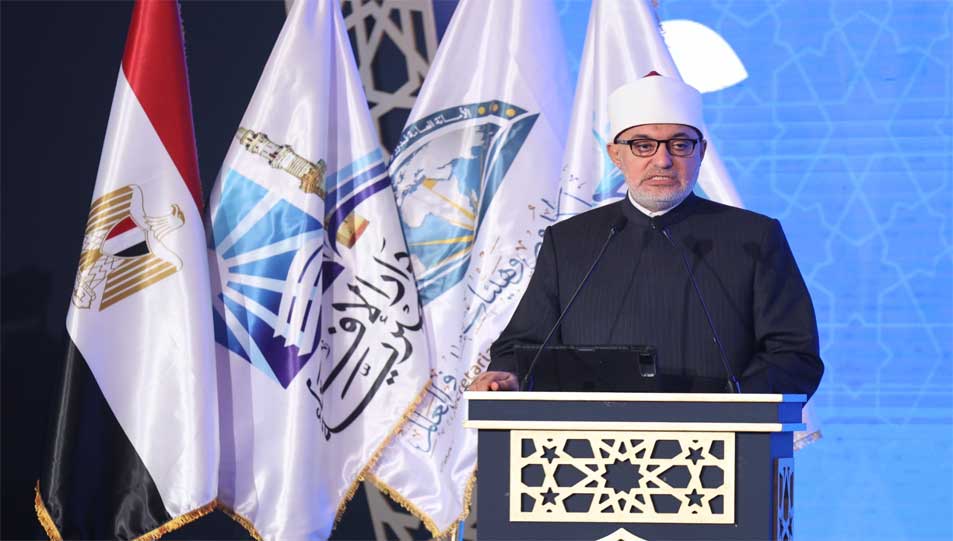
Egypt’s Grand Mufti, H.E. Dr. Nazir Mohamed Ayyad, called for a comprehensive and proactive approach to protecting family stability and identity during the opening of the 11th International Conference in Cairo. He highlighted Egypt’s efforts to address family challenges through personal status legislation, the Family Support Fund, child protection measures, and premarital preparation programs.
Dr. Ayyad warned that rapid digital transformation, artificial intelligence, harmful online content, and the commercialization of human relationships are placing new pressures on families and children’s values. He outlined a four-pillar roadmap focused on Maqasid-based ijtihad in family affairs, digital awareness, correcting misconceptions about family life through moderate Islamic discourse, and expanding premarital and family counseling. He also called for stronger cooperation among religious scholars and specialists in psychology, sociology, education, law, technology, and media to move from reactive responses to proactive protection of families and their identity.
Read full speech
Arab Republic of Egypt
The address of His Eminence, Dr. Nazir Mohammed Ayyad
Egypt’s Grand Mufti
President of the General Secretariat for Fatwa Authorities Worldwide
At the opening session of the annual international conference of the General Secretariat for Fatwa Authorities Worldwide:
“Family Challenges amid Major Transformations: A Fatwa-Based Approach to Protecting the Family, Anticipating Its Future, and Safeguarding Identity”
Under the gracious patronage of His Excellency President Abdel Fattah El-Sisi, President of the Arab Republic of Egypt.
In the Name of Allah, the Most Gracious, the Most Merciful.
Praise be to Allah, Lord of the worlds, and may peace and blessings be upon our master and patron Muhammad, and upon his family and all of his Companions.
Your Excellencies and Eminences, esteemed ministers, grand muftis, representatives of United Nations and international organizations, ambassadors, scholars, statesmen, members of the press and media, and dear guests of Egypt: May peace, mercy, and blessings of Allah be upon you.
From Egypt, the quiver of Allah and the cultural qiblah of the Islamic world, and on behalf of its venerable institutions, I welcome you to your second home and among your own family.
At the outset of my word, I am pleased to extend my highest expressions of thanks and gratitude to His Excellency President Abdel Fattah El-Sisi, President of the Arab Republic of Egypt, may Allah preserve him, for his gracious patronage of this distinguished conference. This patronage reflects the vision of the Egyptian state, which recognized at an early stage the challenges facing the family and responded through presidential directives, including the launch of the “National Project for the Development of the Egyptian Family” and the “Solidarity Fund to Support the Egyptian Family,” in order to ensure livelihood stability, in addition to strengthening community-based, psychological, and material preparation programs for those preparing for marriage, in harmony between the objectives of Islamic law and sound state policies.
Esteemed guests, we are living through blessed days in which we commemorate the birth of the Prophet (peace and blessings be upon him) and recall his sublime family guidance: He was the best of people toward his family; he established his household upon good companionship, affection, and mercy; and he set the noblest example of compassionate fatherhood, upbringing with gentleness, and firmness without harshness.
The title of this conference has been carefully crafted within a rigorous and coherent framework, bringing together four fundamental dimensions: family challenges, major transformations, protecting the family and anticipating its future, and safeguarding identity.
What a momentous issue, and what a great mission and trust! Yet you are its people and, with Allah’s help, fully capable of fulfilling it.
The convergence of these dimensions in a single issue places a doubled responsibility upon our shoulders at a historic moment in which social projects are multiplying and people are being pulled in different directions by competing frames of reference, so that we may present to the world, with penetrating awareness of its movement and transformations, the civilizational model whose foundations were established by the Book of Allah and whose features were embodied by the Sunnah of His Prophet (peace and blessings be upon him). It is a model to which societies exhausted by social crises, in both the East and the West, may turn and through which they may find a path toward restoring balance, stability, and inner peace.
We gather today as the family as an institution faces an unprecedented existential challenge. In previous eras, fatwas generally addressed individual cases and specific emerging issues. Today, however, they confront what may be described as “intellectual fluidity”, a phenomenon that reaches into the very foundations of human nature.
Digital openness and the growing dominance of artificial intelligence algorithms have introduced a value system that is reshaping the consciousness of younger generations. Technology is no longer merely a tool; in many instances, it has become an instrument for reinforcing individualism and isolating people within a virtual cocoon that shapes their choices and fuels their desires.
Some aspects of parental and educational authority have gradually shifted from parents to digital platforms that penetrate the privacy of the home, weakening direct dialogue and family consultation while offering children virtual companions and artificial alternatives that can never provide genuine compassion, reassurance, or the warmth of belonging.
Technology itself is not the problem; rather, the danger lies in its blind adoption as a lifestyle that transforms living human relationships into sterile interactions and disconnects the individual from family and identity.
These challenges, however, extend far beyond the boundaries of open digital platforms. They reach into more concealed spaces, foremost among them the “dark web,” where content and practices circulate that threaten family security and target the natural disposition of children, beyond the reach of meaningful social oversight.
This impact is intensified by “epistemic fluidity,” through which the boundaries between truth and falsehood, knowledge and illusion, and value and desire collapse, until the content that is most widely disseminated becomes more capable of shaping consciousness than content that is most truthful and sound.
The greatest danger posed by artificial intelligence lies in the gradual displacement of parents as the primary educational and moral authority, in favor of Western platforms and algorithms. Children are increasingly turning to digital content for their moral values and even for their understanding of what is permissible and prohibited. Such targeted content can undermine sound upbringing and risk producing a generation increasingly detached from its identity and faith.
This danger is compounded by the erosion of privacy and the undermining of the boundaries of personal life. Through the continuous collection of data and the monitoring of smart devices and individuals’ behavior within their homes, privacy is being subjected to an unprecedented level of intrusion. This can introduce anxiety and suspicion into people’s lives, depriving families of their natural sense of security and peace of mind.
Against this backdrop, the “globalization of values” is accelerating. Value systems that differ from those of particular societies cross borders and are increasingly presented as a single universal human standard. This threatens religious and cultural particularities and competes with the family’s traditional sources of moral guidance. From this emerges what may be called the “triangle of fragmentation”: irreligion, rootlessness, and moral disintegration; namely, severing ties with faith-based reference points, weakening national belonging, and detaching behavior from moral and ethical restraints.
This trajectory is completed by the “commodification of relationships,” whereby the human being is reduced to his or her utility and the marital relationship is measured according to a logic of profit and loss, so that affection, loyalty, and sacrifice become subject to negotiation and replacement.
The situation has become even more dangerous as some social-media platforms have been transformed into arenas for an artificially manufactured conflict between men and women, portraying marriage as a battle between a winner and a loser—when in fact both are losers—in the absence of the spirit of tranquility, affection, and mercy.
Noble Islamic concepts have likewise been distorted: “qiwāmah” (guardianship and responsibility) is portrayed as domination rather than care and responsibility; “obedience” is portrayed as the erasure of personality rather than the organization of family affairs; and the meanings of “al-kadd wa al-saʿāyah” that preserve a woman’s dignity and recognize her effort have been overlooked.
At the same time, calls to abstain from marriage are becoming increasingly widespread, while casual relationships and aberrant relationship models are promoted in a systematic attempt to disseminate imported ideas aimed at normalizing relationships rejected by people of sound human nature, such as advocating different forms of union between men and women, including “cohabitation,” in contrast to the traditional family model, referred to as the “biological family,” as well as “the practice of homosexuality,” all under claims of freedom guaranteed to every human being, alongside other behaviors rejected by custom and sound taste.
Meanwhile, the costs of marriage and the exaggeration of social appearances weigh heavily upon young people and make it difficult for them to establish families.
Amid this complex landscape, two opposing currents increasingly compete for the minds and consciousness of young people: extremism and digital atheism. Both can feed on emotional emptiness, exploit vulnerable or underdeveloped awareness, and capitalize on the illusion of knowledge.
Esteemed Scholars,
At Egypt’s Dar al-Ifta, and through it the General Secretariat for Fatwa Authorities Worldwide, we proceed from an institutional legacy extending for more than one hundred and thirty years. Through this legacy, we recognize that the fatwa is not merely an answer to a question, but the steering the course of life in light of the Divine revelation.
Here we recall the principle laid down by Imam al-Shafi‘i, may Allah have mercy on him, when he stipulated that a mufti should be “well acquainted with the differing views of the scholars of the various lands.”
A fatwa cannot therefore retreat into the past or remain confined to literal transmission and juristic characterization after a dispute has occurred. Rather, it must advance toward what we call “anticipatory fiqh”: a jurisprudence that addresses causes before consequences occur, monitors outcomes, and fortifies minds before they are penetrated and shaped by screens and digital influences.
From this platform, and in the face of these profound transformations, our responsibility in the fields of fatwa and maqasid-based jurisprudence requires us to adopt an integrated approach founded upon four essential pillars:
First: Activating maqāṣid-based ijtihād in family affairs: by drawing upon the higher objectives of Islamic law to achieve justice and mutual compassion, while carefully balancing the immutable principles of religion with the changing circumstances of the age.
I therefore call for “Maqasid-Based Ijtihad in Family Affairs” to be established as a core subject in the education of Sharia students at both undergraduate and postgraduate levels. This is essential to preparing a new generation of muftis capable of delivering sound and balanced fatwas—fatwas that neither succumb to the rigidity of blind traditionalism nor fall into the excesses of unfettered permissiveness.
Second: Engaging in the battle for digital awareness: by producing reliable, accurate, and accessible fiqh-based and scholarly content in multiple languages, explaining family concepts in contemporary language informed by the nature of technology, so that it may serve as an authentic reference upon which search engines rely and from which artificial-intelligence applications draw, rather than leaving the field to inaccurate or biased content.
Protecting the family’s awareness begins with protecting the digital information that shapes the minds and consciousness of future generations.
Third: Courageously correcting erroneous family misconceptions. We must confront rigid extremist discourse that alienates young people, as well as waves of digital atheism that dismantle morality, through a moderate and compassionate discourse inspired by the guidance of the Prophet (peace and blessings be upon him).
This must go hand in hand with expanding pre-marital preparation programs and strengthening family counseling after marriage; restoring spaces for meaningful dialogue within the home; and establishing thoughtful boundaries for digital use. In doing so, we can help our children regain their confidence in the family as their primary source of guidance and as a sanctuary of protection, security, and belonging.
Fourth: Establishing cross-disciplinary institutional partnerships that bring together scholars of Islamic law and experts in sociology, psychology, education, technology, media, and law, because a complex reality cannot be addressed through one-dimensional solutions.
It is no longer sufficient for institutions to operate in isolated silos. What we need is sustained knowledge-sharing and a form of institutional collective wisdom that brings together the authenticity of the revealed text, the depth of scholarly analysis, and a nuanced understanding of the digital world—all within the overarching framework of the spirit, objectives, and justice of Islamic law. The Egyptian state, under its wise leadership, has recognized the importance of such integrated and coordinated approaches in addressing the complex challenges facing society.
Esteemed Gathering,
The Almighty has described the methodology of referring matters to those qualified to address them, saying, “When there comes to them information concerning security or fear, they spread it about. Yet if they had referred it to the Messenger and to those in authority among them, those capable of determining its true implications would have understood it” (Quran, 4:83).
And you, esteemed scholars, are among those entrusted with this profound task of discernment and inference. The trust placed upon you is weighty, and the responsibility is immense—but, by Allah’s grace, you are worthy of carrying it.
Today, we are called upon to broaden the horizons of scholarly fatwa so that it may engage directly with the pressing concerns of humanity, foremost among them the institution of the family. This requires a renewed vision of fatwa—one that anticipates the future and brings living, flexible juristic reasoning into constructive dialogue with the sciences of medicine, psychology, sociology, technology, and law.
Only through such an integrated approach can we provide protection that anticipates danger, solutions that address its underlying causes, and an identity that remains open to the contemporary world without losing itself within it.
From this platform, I reiterate my call for “Maqasid-Based Ijtihad in Family Affairs” to be established as a core subject in the curricula of Sharia faculties at both undergraduate and postgraduate levels. This would ensure that students of Sharia are equipped to deliver sound and balanced fatwas on family matters—fatwas that neither succumb to rigid imitation nor drift into unrestrained or aberrant interpretations.
In conclusion, I extend my deepest thanks and appreciation to all those who have undertaken the journey to join us at this distinguished gathering; to every dedicated member of the teams at Egypt’s Dar al-Ifta and the General Secretariat for Fatwa Authorities Worldwide; and to the executive, security, and media authorities whose efforts have contributed to the successful organization of this conference.
With the blessing and guidance of Allah, I hereby declare the opening of the proceedings of your esteemed conference. I pray that Allah Almighty crown your efforts with resolutions and recommendations that will serve as an impregnable shield protecting our families and a secure refuge for our societies.
“And Allah invites to the Home of Peace and guides whoever He wills to a Straight Path” (Quran, 10:25).
And peace, mercy, and blessings of Allah be upon you.